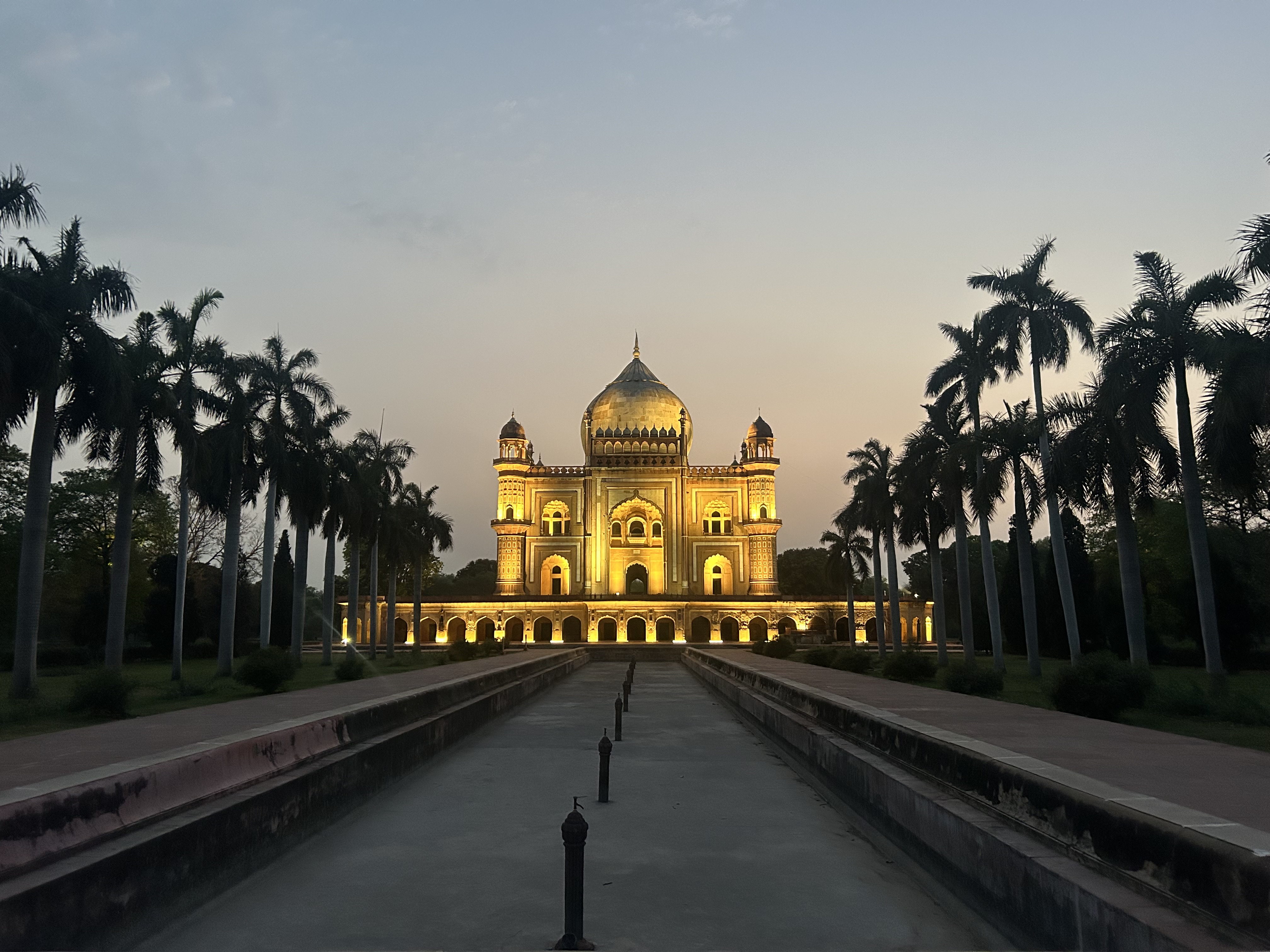
Safdarjung – A Mobile-Loving Tomb

Safdarjung Tomb in Delhi loves anyone with a mobile camera.
The edifice lures mere mortals inside—especially at dusk—with the sole intent of getting itself photographed.
Entry to Safdarjung Tomb

If one can pass oneself off as someone below 14 years of age, entry is free.
The only condition—one has to pose appropriately for a photograph.
Who Was Safdarjung?
Wazir-ul-Mamalik-e-Hindustan Asaf Jah Jamat-ul-Mulk Shuja-ud-Daula Nawab Abul Mansur Khan Bahadur Safdar Jang Sipah Salar—whew!
Safdarjung is much easier to recollect.
Born in Neyshabur (modern-day Iran), the city of Omar Khayyam, Mr. Safdarjung migrated to India, became one of the most powerful individuals in the Mughal court, was later banished to Sultanpur in present-day Uttar Pradesh, had an equally ambitious wife (Sadr-i-Jahan), and today both are interred in the same monument.

Politics, Alliances and Power
His political alliances make the modern-day politician look like a novice.
Marathas, Rajputs, Mughals—and who not?
Alliances were both his greatest strength and his eventual bane.
He keeps reminding us of all the “kursiyon ka kissa” through strategically placed objects.


The Tomb That Loves Photography
He has an overprotective guard.
No mob can deter his personal security.
His loyal guard ensures everyone is driven out before dusk, so that he can dress up for a photo session—with the palm trees serving as his veil.

A sprinkle of bird glitter as ornament makes him shine.

And do the cameras love Mr. and Mrs. Safdarjung!
It’s almost as if mobile cameras were invented for them.
Hidden Corners of Safdarjung Tomb
A quiet nook exists to attract the connoisseur—a Rangan Dutta, a William Dalrymple—people who inspire other people to photograph.

They fail miserably when it comes to partners engrossed in each other.
Including this gentleman—so absorbed in his mobile phone that he forgot to photograph an illuminated mausoleum.
Sacrilege!
The Residents Beyond History
The entombed family provides a space for its pets.
And ensures a little bit of snacks for the trapped mobile photographers.
Always gifting a rose of affection and gratitude.
And then they pose for all—for as long as one wants.
Final Thoughts
The last prominent remnant of an era past its prime—the family of the Nawab of Oudh—makes sure they continue to live for posterity through countless photographs in visitors’ galleries.